
 966
966




6 May 2026: The Management Board of the Central Bank of the Republic of Azerbaijan decided to keep all parameters of the interest rate corridor unchanged.
The decision was made considering the alignment of actual inflation and forecasted inflation with the target range, the risks arising from heightened geopolitical tensions, the global financial conditions, the domestic macroeconomic environment, as well as the transmission of monetary policy decisions to the real sector.
Annual inflation remains within the target range. In March 2026, 12-month inflation stood at 5.6%. Annual price growth amounted to 6.5% for food, alcoholic beverages and tobacco products, 5.7% for paid services and 3.7% for non-food products. Annual core inflation stood at 5.5%.
Over the past period of current year, supply prevailed over demand in the foreign exchange market. According to preliminary estimates, over 4 months of 2026 cash foreign currency purchases by exchange points exceeded sales by $190M. The dollarization level of resident individuals’ deposits decreased by 2.1 percentage points over recent 12 months to 28%, attributable to optimistic exchange-rate-related expectations. The Central Bank absorbed excess liquidity in the FX market after banks’ demand fell sharply during currency auctions held in April, resulting in a surplus of foreign currency supply. Consequently, over four months of the current year, foreign exchange reserves of the Central Bank increased by 10.2% to $12.7B.
During this period, the external sector indicators remained favorable. According to the State Customs Committee, the trade surplus amounted to $1.4B in Q1 2026, which exceeds the indicator for the same period of last year by 93.3%. The Central Bank revised upward its forecast for the current account surplus for 2026 and 2027, citing rising prices for the country’s main export commodity and continued expansion of non-oil and gas exports.
Monetary policy tools are applied in response to financial market developments and liquidity indicators of the banking system. In the unsecured money market, short-term interest rates are formed within the Central Bank’s interest rate corridor, remaining close to the policy rate. The average daily AZIR rate stood at 6.47% in March and 6.44% in April 2026.
Under the baseline scenario, annual inflation is projected to remain within the target range in the current and next year. According to the Central Bank’s May projections, annual inflation is expected to reach 5.9% in 2026 and 4.5% in 2027. The upward revision to the inflation forecast is mainly driven by stronger external cost pressures, including rising global food prices, increasing inflationary pressures among trading partners, and a slower pace of appreciation in the nominal effective exchange rate. Weaker demand-side factors compared with the February forecast partially offset the upward impact of supply-side pressures on inflation. Overall, the May projections suggest that inflation is expected to be driven primarily by supply-side factors.
Rising geopolitical tensions since the last meeting have increased the role of external factors in the balance of inflation risks. The conflict in the Middle East disrupted supply chains, leading to high transportation and insurance costs, while also triggering volatility in global energy prices. Persistence of these developments for the rest of the year will be the main factor determining the dynamics of inflation in trading partners. International financial institutions have already revised their global inflation forecasts for the current year. Looking ahead, the scale of imported inflation will depend both on inflation trends in trading partner countries and on movements in the nominal effective exchange rate. At the same time, as inflation expectations could stimulate consumption more strongly than anticipated, they remain the primary domestic risk factor for inflation.
Decisions on the parameters of the interest rate corridor will depend on changes in the inflation outlook, as well as results of macroeconomic assessments. The Central Bank stands ready to take appropriate policy measures should there be a risk of inflation exceeding the target range.
The next decision on the interest rate corridor parameters will be made public on 24 June 2026.
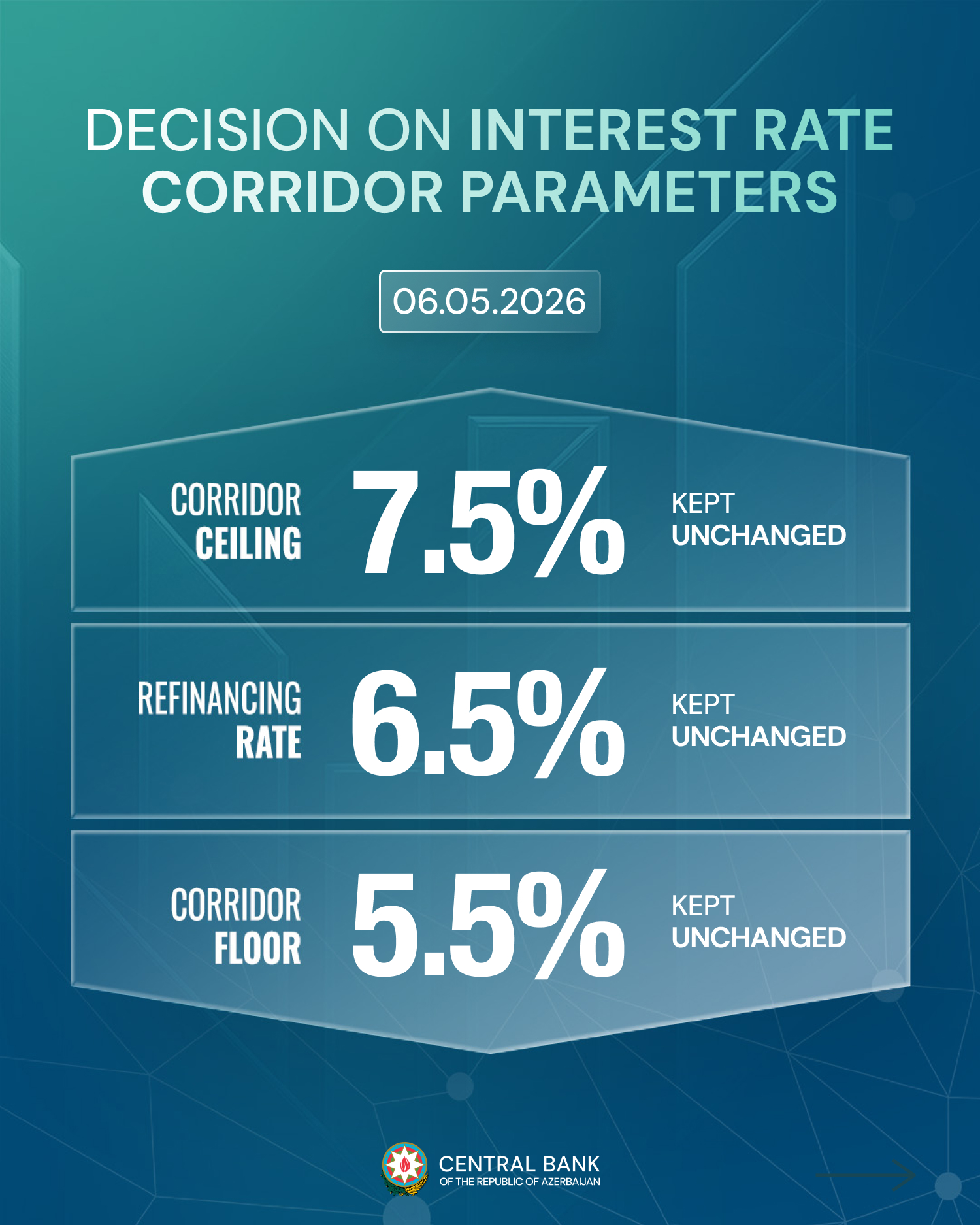
06.05.2026